Loading…
§ Case study · Armada Content Director · 2026
I built the platform, not the prompt.
A two-sided content engine: cron-fed sources (news, trends, SERP, rank data) stream in and get processed, feed a multi-agent generator, then publish out to planned slots. Collect, generate, distribute.
- Client
- Armada Security · Content Director
- Industry
- AI · content-ops platform
- Role
- Designed + built the platform: multi-agent pipeline, 4-axis scoring, GSC/SERP data layer, content-ops UI
- Year
- 2026
Generic AI writing is everywhere and it ranks nowhere. A one-click ChatGPT blog post is fact-thin, sounds like every other AI post, and can’t tell you whether it’ll actually outrank the live top-10. For Armada Security I didn’t want a prompt. I wanted a platform. So I designed and built Armada Content Director: a modular, multi-agent system that researches, writes, scores, validates, and publishes SEO content grounded in real rank data, and keeps improving it.
Product & UX design40+ UI surfacesMulti-agent pipelineNext.jsAnthropic / OpenAI / GoogleSQLiteGoogle Search ConsoleDataForSEOWordPress
The interface I designed
The platform lives or dies on one screen: a content lead opens it and has to know, in five seconds, whether the brand is healthy and what to do next. So the Command Center leads with a single graded health score, then breaks it into the five bars that actually move it (published volume, content score, image coverage, schema, freshness), each one a link to the surface that fixes it. A brand switcher at the top scopes the whole platform to one client; everything below re-reads in place.
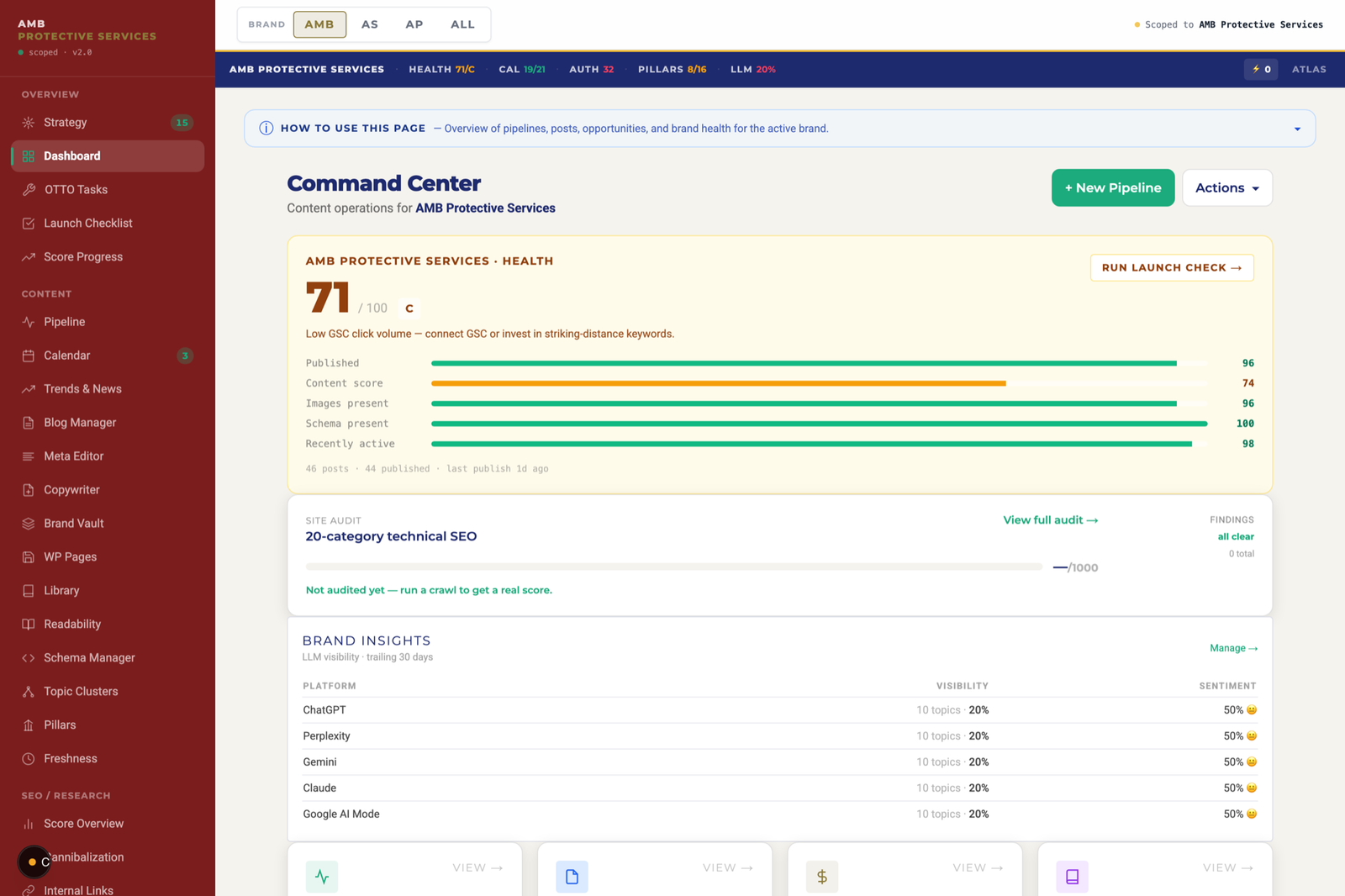
The left rail is the real information-architecture work: 40+ surfaces (Strategy, Pipeline, Calendar, Blog Manager, Topic Clusters, Schema Manager, Internal Links, Cannibalization, Site Audit, Rank Tracker) folded into six collapsed groups (Overview, Content, SEO / Research, GEO / AEO, Assets, System), each carrying a live count badge so the rail doubles as a worklist: “SEO / Research · 99+” is not a label, it’s a queue. The brand’s five vitals ride in a pill row at the top of every page, so no matter how deep an operator goes, the health, calendar, authority, pillar and LLM numbers never leave the screen. The hard part wasn’t building the screens; it was making forty of them feel like one product.
The thesis: a Lego platform, not a prompt chain
The core decision up front: this would not be a monolithic chain of prompts. It would be a set of replaceable services connected by shared data contracts, so any module could be swapped, upgraded, disabled, or re-ordered without breaking the whole system, as long as it honored the input/output contract. And one rule was non-negotiable: a contract-validator layer is mandatory. Every module’s output is validated against schema, quality gates, and business rules before it can move downstream. Invalid output comes back with structured remediation notes instead of poisoning the next step.
The generation pipeline
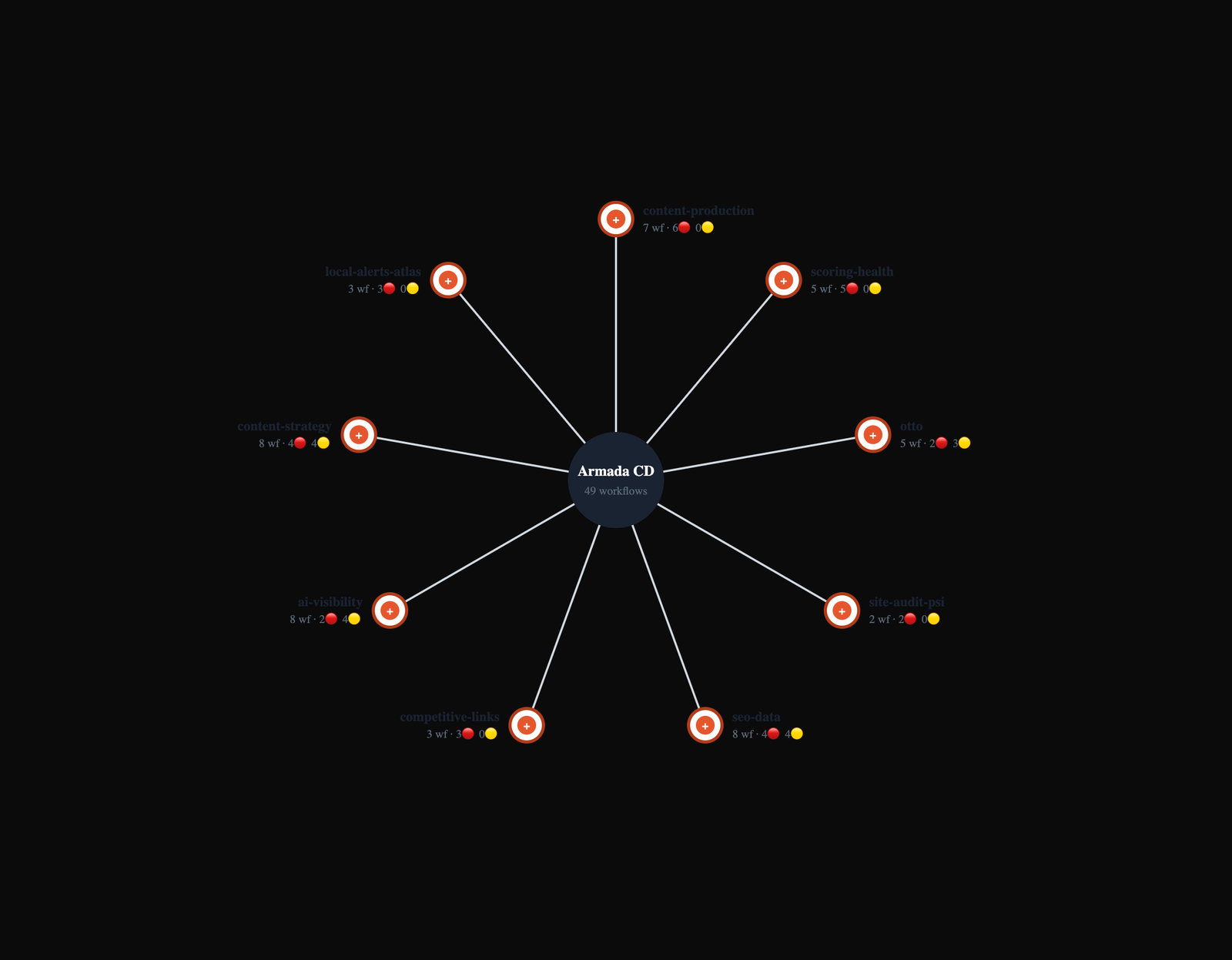
Content moves through a chain of specialized agents, each with one job and a validated handoff:
The Evidence Ledger grounds the piece in facts before a word is written. The Audience Strategist frames it for the actual buyer. The Writer produces it in-voice. The Validator gate enforces the contract. The Schema Planner emits the structured data. Evidence first, voice second, validation always: the opposite of one-shot generation.
Scoring on four axes, not someone else’s number
Every page is scored on four dimensions: SEO (will search engines rank it), AEO (will answer engines quote it), GEO (will generative AI cite it), and E-E-A-T (does it carry real experience, expertise, authority, trust). I built it as one rubric (the Armada Content Score) and deliberately never claimed equivalence with Surfer or Search Atlas. It’s our own opinionated bar, shown alongside third-party numbers, not pretending to be them.
4scoring axes: SEO · AEO · GEO · E-E-A-T
14-pointLaunch Check gate before anything publishes
240+API routes across 40+ content-ops surfaces
3model providers: Anthropic, OpenAI, Google
Grounded in real rank data, not vibes
A “striking distance” badge means nothing if it’s running on AI-guessed positions. So I wired Google Search Console as the rank-truth source: real impressions and positions per brand, OAuth with encrypted refresh tokens, synced daily, banded into Highest Rank / Traffic / Striking Distance / Developmental. Opportunity scoring, freshness-decay alerts, and cannibalization detection all read from that real data. GSC-confirmed signals beat AI-inferred ones on conflict.
For competitive reality, a SERP-grounded audit fetches the live top-10 for a keyword, crawls each result, and computes a concrete gap (word count, topical coverage, competitor parity), so an editor optimizes against what’s actually winning, not a rubric in a vacuum. I built the SERP and backlink layers behind provider interfaces (DataForSEO primary, free fallbacks) so the platform never gets locked to one vendor or one bill.
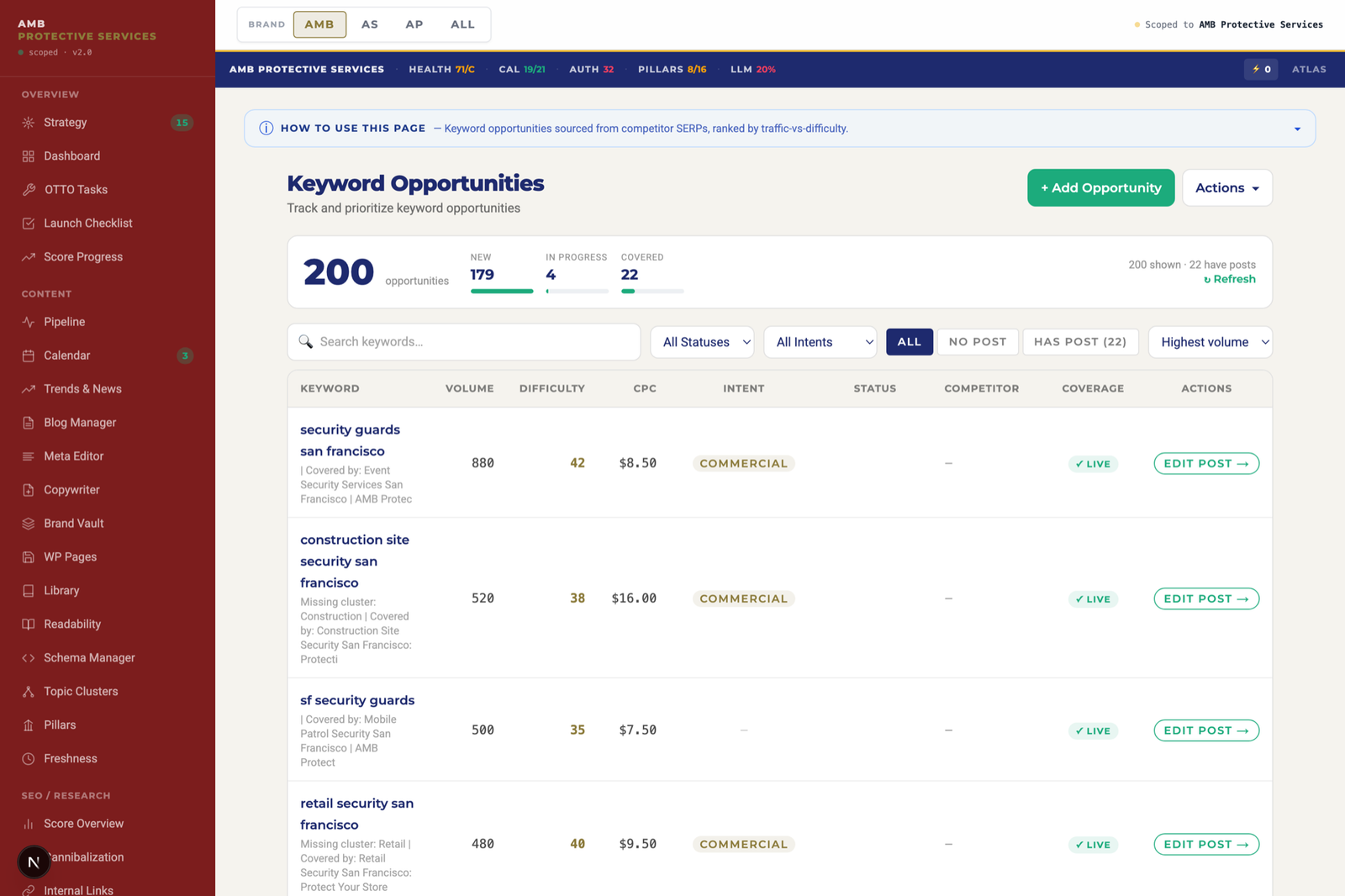
All of that surfaces in the screen an editor actually lives in: the Opportunities table. Every row is a real keyword with its volume, difficulty, CPC, intent, and coverage state, sorted so the highest-leverage gap floats to the top. The design job was to compress six dimensions of decision into one scannable row with a single next action (Edit Post) so research turns into a draft without a context switch.
From generate-one-post to run-a-catalog
The generation pipeline was V2. The harder design problem was V3: the control plane around it, so an editor manages a catalog, not one post at a time. Discovery surfaces (Opportunities, Content Gaps, Topic Clusters with embedding-based assignment, Coverage Matrix, Cannibalization). Optimization surfaces (AEO Optimizer, Schema Manager, Internal Links with bulk-apply, Readability). Tracking surfaces (Score Progress over time, Freshness decay alerts, the Launch Check gate). And export/publish straight into WordPress, local-first then pushed to production.
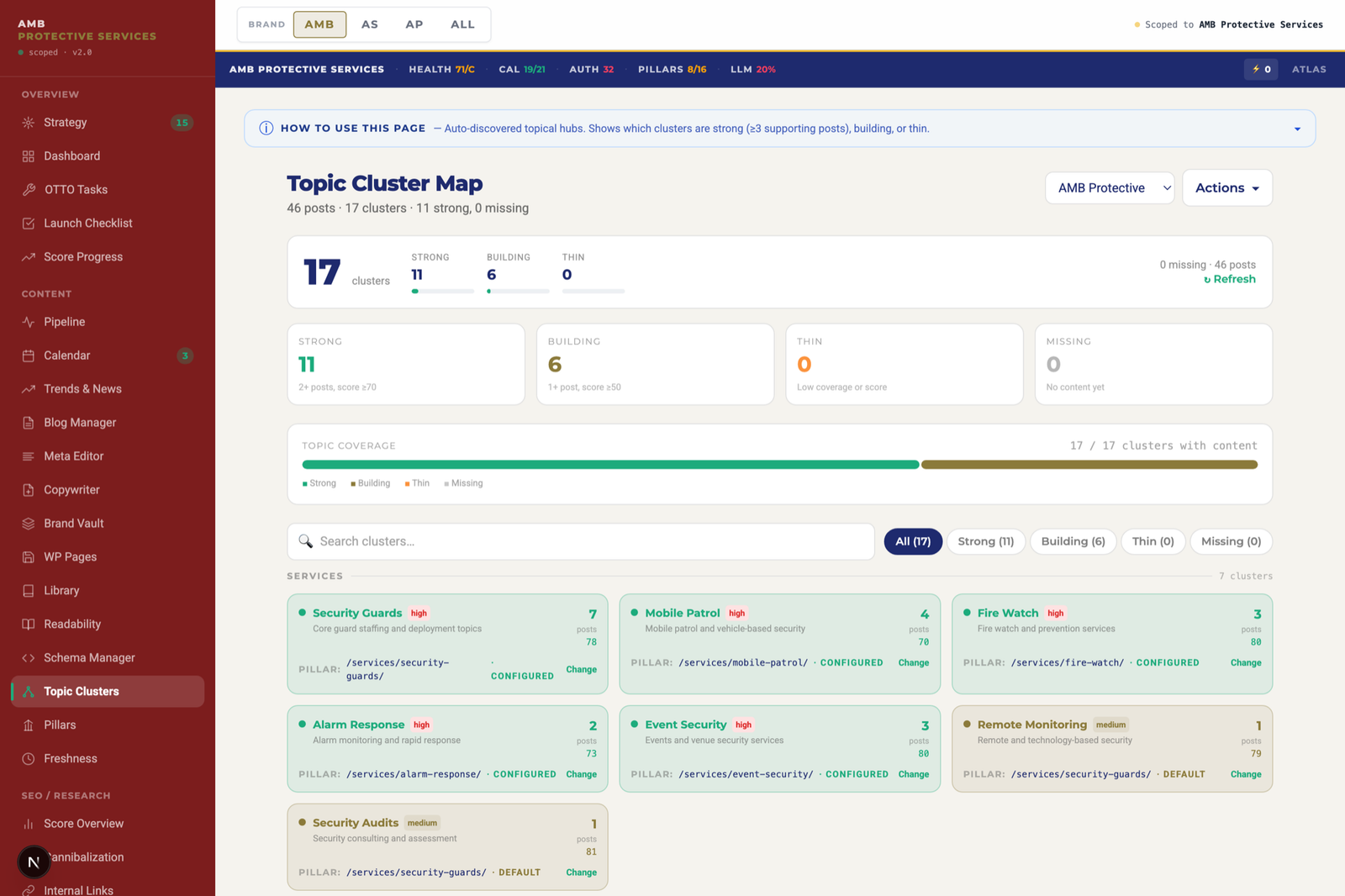
The Topic Cluster Map is where that catalog-level thinking becomes visible. Posts are auto-assigned to topical hubs by embedding similarity, each cluster graded strong / building / thin against its pillar URL, so a strategist sees the shape of their authority, not a list of posts, and knows exactly where the next piece has to go.
Why this is the work I’m proudest of
It’s the full thesis in one system: an AI-native product that turns an ambiguous business goal (“rank for high-value security keywords without shipping generic junk”) into a production platform with real data contracts, real rank truth, and a validation layer that refuses to ship slop. It started scoped to one vertical (construction-site security, two services) and was architected from day one to extend to new industries, services, and locations by swapping modules, not rewriting the chain. That’s the difference between a prompt and a platform.
What I’d do differently
Close the loop from score to outcome faster. The platform measures content quality on four axes and tracks GSC rank, but the cleanest proof is “this score moved this ranking moved this many calls.” I’d wire conversion data (GA4 ingestion is scaffolded but unused) into the same timeline as the score and the rank, so the dashboard tells the whole story end to end, not just the content half.
Armada Content Director, designed and built by Andrey Gurov, 2026. A modular multi-agent content-ops platform (Next.js · multi-model AI · SQLite · GSC · DataForSEO · WordPress).